Juggling work, family and exam preparation is never easy. As English teachers and examiners, we’re often asked how busy professionals can improve their fluency and confidence without spending hours every day studying. Here are five strategies that really work.
1. Set a REALISTIC goal and STICK to it
Look ahead at the coming week and try to identify at least 2 times (ENGLISH FOR ME TIMES) when you will sit down and devote time to your English. Identify a time when you usually scroll through social media on your phone, binge watch Netflix or sit on the bus stuck in traffic! It doesn´t matter if it is only 10 minutes the first week, the important thing is to MAKE A START.
Examples of “English for Me Time”

Ideally you will combine receptive and productive English practice into your routine, so if you are able to attend an English class with a teacher you will be able to develop your fluency and activate the vocabulary and grammar you have been studying during the week.
2. Give Your Brain Multiple Chances to Learn
I like to imagine our brains as a muscle and our language ability as something which can be developed through the making of thousands of connections and links and then activating those links again and again.
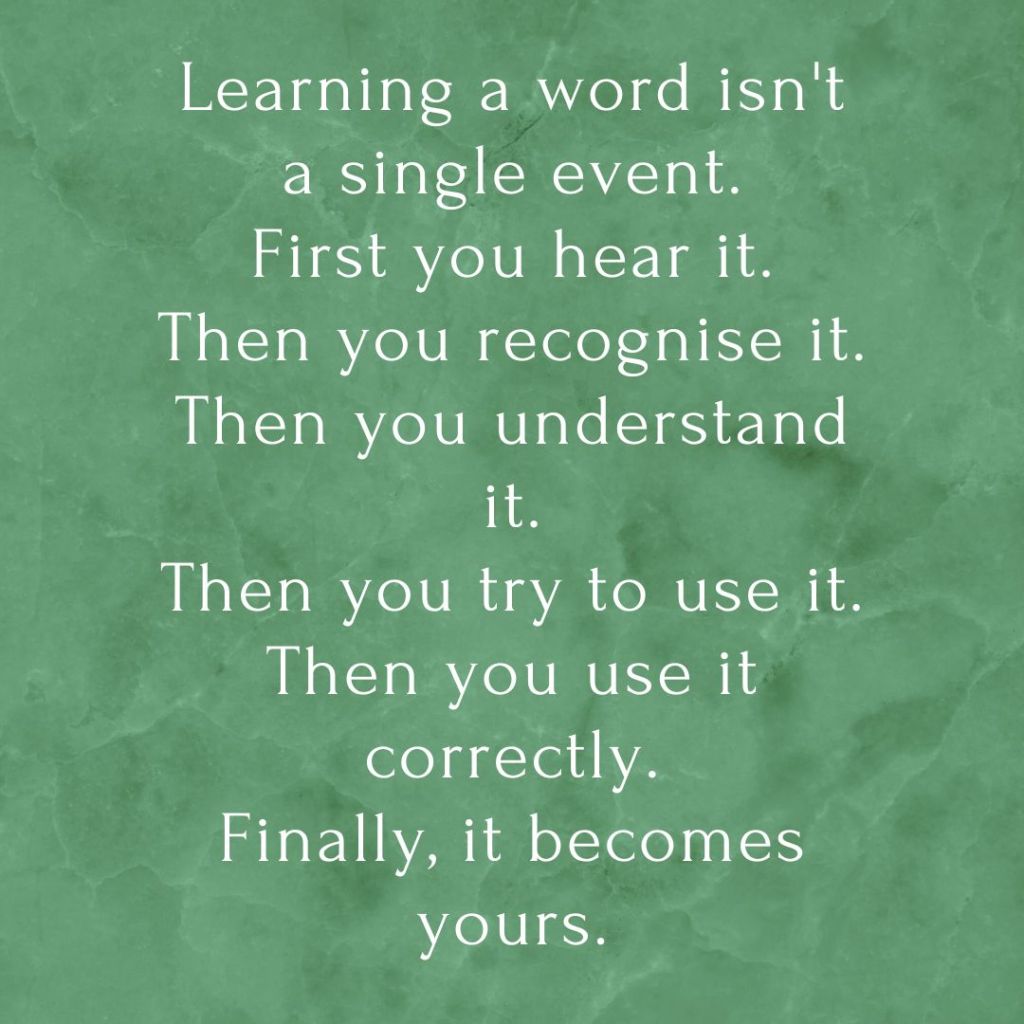
The first time you hear a word you try to make sense of it. Sometimes you can guess the meaning from the context, other times you need to ask a teacher or look it up. The next time you see the word it appears vaguely familiar. The following time you recognise it immediately. Then one day you feel brave enough and you try to use it. Your teacher corrects your pronunication and maybe the preposition you use with it and even sometimes tells you that this is not an appropriate use of the word. But then the next time you use it correctly to express something you want to communicate! It is the perfect word for the situation and the message you want to convey! You feel on top of the world!
So that is what needs to happen with your language studies.
You need many varied opportunities to absorb, recognise and try out the vocabulary and expressions you are learning. So my advice would be that each week you ensure that you balance receptive skills such as listening and reading (input) with productive skills such as writing and speaking.
Ideally try to combine skills. Even though it can feel like hard work at the beginning, it is a much more natural way of studying. In real life we communicate in many forms, so the same needs to happen when you are studying for an exam. To pass a high level exam like the Advanced/C1 you will need to show an ability to understand and express yourself in English in a way which can transmit complex concepts and feelings. Unless you are lucky enough to have spent time in an English-speaking environment (living abroad/working with international colleagues) this may feel out of your comfort zone.
Creating a mini “Task” including input (such as reading/watching/listening) and output (speaking and writing) will provide you with great expressions, vocabulary and structures to use yourself in your own words:
- Write an article stemming from an interesting podcast you listen to, make it personal and something that you personally would enjoy reading.
- Watch a film, read other peoples’ reviews of the film online then record yourself giving your own opinion on the actors, storyline, special effects and genre.
- Find essays on a topic that you are unfamiliar with and then prepare a mini-presentation summarising the key points, adding in your own opinion at the end.
3. Find something you enjoy and forget you are studying
Working towards an English exam such as the C1, B2 APTIS, Cambridge or LanguageCert exams can sometimes feel like a full time job. This can become overwhelming when you are also working, looking after a family or have other commitments. It is essential that you find enjoyable, comfortable ways to maximise your exposure to English, without becoming burnt out and exhausted.
Explore English language TV series; it could be absolutely anything that gets you hooked. In my case (learning Spanish) it was “Hospital Central,” but you might prefer a cooking competition, a teen romance sage or a science or technology documentary. In my opinion, the genre really doesn´t matter. The key is to find something that you can watch, or listen to, regularly, without feeling guilty! You can recharge your batteries and relax, at the same time as developing your listening skills. Listening really is the key to having good vocabulary, pronunication and grammar – don´t be tempted to see it as a separate, stand alone skill.
For some learners, a language immersion experience can be a fantastic way to accelerate progress by combining speaking, listening and confidence-building in a real-world environment. Obviously that is an extra expense in terms of time and money, but is a great investment in your ability to communicate in English. We offer an intensive English immersion weekend at our home in El Boalo, 45 minutes outside of Madrid as well as longer immersions in summer in the Sierra and in England. There are other options all around the world that you can find.
4. Take advantage of technology
When you feel tempted to start scrolling through instagram, Pinterest, the news or whatever, opt for a language app such as DuoLingo or LingQ. Even 5 minutes every day will activate the English you are learning and keep working your language ‘muscles’. Other websites such as the British Council, Test English and Flo-Joe offer you the chance to practice all of your exam skills in a fun and accessible way.
Paul and I often set our students weekly homework completing activities from these websites to practice grammar, vocabulary or skills we are working on in class. The advantages are that many provide an autocorrect facility, so you can immediately identify your errors and then we can address them and practice more in class.
You can also make use of apps such as Tandem, to find a language exchange partner to practice English daily and make a friend at the same time! AI tools can also be useful for speaking practice. You can ask ChatGPT or similar tools to role-play job interviews, simulate meetings, explain grammar points or give feedback on your writing. Used well, they can provide valuable extra exposure to English between classes.
5. Growth Starts Outside Your Comfort Zone
‘Feared things first.’
This is an expression my mother used a lot and I have never forgotten. What scares us brings us so much worry, and often the worrying is worse than the thing you actually are scared of doing!
So, for many of my students, the thing they are most nervous of is:
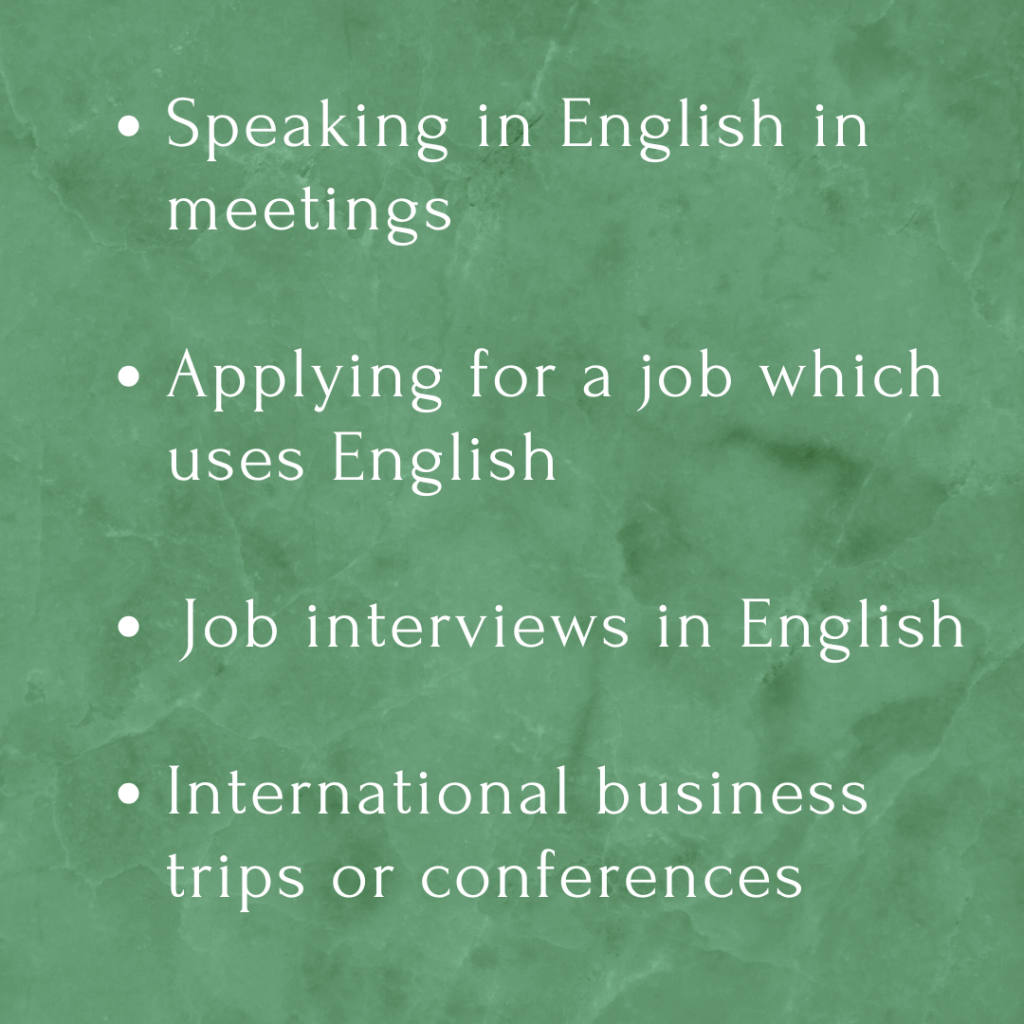
This is perfectly natural. As a professional, you want to be your best when you communicate with co-workers, managers or clients.
BUT … what happens if you avoid conferences, put off applying for jobs and rely on other more confident co-workers to speak in meetings?
You won’t improve. You will stay in the shadows waiting for the magic moment to come when you can speak English like a native, with no mistakes = never!
The example of Ana
As a teacher I get great satisfaction from students of mine like Ana, a well resepected scientist in Spain, who was terrified of speaking in public in English. Partly due to our classes, but honestly, much more due to her own bravery, over the past year she has attended a number of events, online and in person in Europe. She has done it.
She has stopped looking for excuses not to attend events and hide behind teammates. Ana recently told me how proud she feels because she can see that the other people do understand her, she understands them… mostly… and if not, she has the tools to ask them for clarification.
By going to all these events, Ana is actually improving faster than ever. She didn’t wait until she felt confident to start speaking English. She started speaking English, and confidence followed.
Exposure to real-life meetings, in your business area is invaluable in order to:
- hear the vocabulary you read every day in emails being used and pronounced in different accents in conversations and presentations
- pick up expressions used in meetings which are specific to your business area or popular in your company culture
- give your brain (and mouth) the practice it needs at formulating responses in real-time (instead of hiding behind chatgpt-assisted emails
- give you the chance to get to know international co-workers in person (and visa versa), creating a bond which will make you feel more comfortable asking each other for assistance on projects or those quick questions that could be answered in 30 seconds if you just pick up the phone and ask
Maybe you will only say one sentence in your first meeting. That doesn’t matter. You need to break the ice and break the habit of either relying on translation or staying silent in meetings. Trust me, if you start today, you will feel completely differently and the exam that you are preparing for will feel much more natural.
Start today
When you make English (or any language you are studying) part of your daily life, be it for travel, work, socialising, relaxing or even romance (!) then the exam you are preparing for will stop being the goal and start to be the cherry on top. Learning a language should never be just about passing an exam. It should be about opening doors, being yourself, and connecting with people from all over the world.

